Miles Byrne (he spelled it Miles rather than Myles) was born in the townland of Ballylusk near Monaseed, County Wexford, Ireland, on March 20th 1780, into a Catholic farming family. At the age of 17, he was asked to join the government Yeomanry. He chose instead to join the Society of the United Irishmen.
In this role Byrne participated in preparations in Wexford for the 1798 Rebellion. At the age of 18 he fought at the Battle of Tubberneering on June 4th. He command a division of pike men in the attack on Arklow on June 9th in which the rebel leader Father Michael Murphy was killed. In the face of a general rout, he led a rebel charge in the Battle of Vinegar Hill on June 21st.
Byrne seized Goresbridge
Maintaining command of a small band, Byrne seized Goresbridge in Co Kilkenny on June 23rd where he deplored the killing of several prisoners by his men in revenge for the torture and executions that had been visited upon the population by the yeomanry and government militia. After further engagements and skirmishes, he joined General Joseph Holt and Michael Dwyer. They took to the Wicklow Hills to continue a guerrilla resistance.
Escape to Dublin
After Holt accepted terms (transportation to Australia) in November, Byrne, assisted by his sister, escaped to Dublin. He recalled of his sister: “If I had not remarked a long scar on her neck, she would not have mentioned anything herself. A yeoman … threatened to cut her throat with his sabre if she did not tell instantly the place in which I was hiding. The cowardly villain, no doubt, would have put his threat in execution had not some of his comrades interfered to prevent him”.
Robert Emmet and Anne Devlin
In the winter of 1802-03, Byrne entered into the plans of Robert Emmet and Anne Devlin for a renewed uprising. In his Memoirs, Byrne describes a meeting he arranged between Robert Emmet and the Wexford rebel leader Thomas Cloney at Harold’s Cross Green, Dublin, just before Emmet’s Rebellion: “I can never forget the impression this meeting made on me at the time – to see two heroic patriots, equally devoted to poor Ireland, discussing the best means of obtaining her freedom.”
The Plans Unravelled
In July 1803, the plans unravelled when Michael Dwyer (Anne Devlin’s cousin), still holding out in Wicklow, recognised that there were neither the promised arms nor convincing proof of an intended French landing. In the north, Thomas Russell and James Hope found no enthusiasm for a renewal of the struggle in what in ’98 had been the strongest United Irish and Catholic Defender districts.
Emmets Rising
In Dublin, with their preparations exposed by an accidental explosion of a rebel arms depot. Regardless, Emmet proceeded with plans to seize the centres of government. The rising, for which Byrne turned out with Emmet and Malachy Delaney in gold-trimmed green uniforms, was broken up after a brief confrontation in Thomas Street. Unaware that John Allen was approaching with a band, according to one witness, of 300, Emmet ordered what R.R. Madden recorded as “a motley assemblage of [80] armed men … under the evident excitement of drink” to disperse.
Two days after the fight in Thomas Street, Byrne met with the fugitive Emmet and agreed to go to Paris to seek French assistance. But in Paris, he found Napoleon’s attentions as in 1798 focused elsewhere.
Napoleon’s Irish Legion
Byrne was commissioned as a captain in Napoleon’s Irish Legion. But at a time when Byrne was convinced that “all Catholic Ireland” was “ready to rise the moment a rallying point was offered”. However, the Irish exiles Thomas Addis Emmet and Arthur O’Connor chief among them could not deflect the First Consul from other priorities.
Brigadier General
Rather than in Ireland, with his diminishing Irish contingent, Byrne was to see action in the Low Countries, Germany and Spain. Byrne rose to the rank of brigadier general and was awarded the Legion of Honour in 1813. Following the Bourbon Restoration, with fellow legionnaire John Allen, Byrne narrowly avoided deportation as a foreign Bonapartist. An introduction to the Prince de Broglie, then vice-president of the Chamber of Deputies, and two audiences with the Minister of War, Marshal Henri Clarke, the Duke of Feltre (a son of Irish parents, who had advised Wolfe Tone) contributed to the latter’s decision to quash the deportation order. In August 1817, Byrne was naturalised as a French citizen.
For much of the next decade, Byrne found himself effectively retired on half pay. Returned to active military service in 1828, he distinguished himself in the French expedition to Morea during the Greek War of Independence and retired in 1835 with the rank of Chef de Bataillon.
Correspondent for The Nation
In the 1840s, Byrne was Paris correspondent for The Nation in Dublin, the Young Irelander paper that, under the early direction of Thomas Davis, did much to rehabilitate the memory of the United Irishmen.
Miles Byrnes Memoirs
In his last years, Byrne wrote his Memoirs, which are an account of his participation in the Irish rebellion and his time in the Irish Legion of Napoleon. These were first published in three volumes in 1863 (under the direction of his widow, Fanny), but there have been many subsequent reprints. Stephen Gwynn, who edited and published a new edition of Byrne’s Memoirs in 1907, stated in his Introduction to Volume 1: “I owe my acquaintance with these Memoirs to Mr John Dillon, who spoke of them as the best of all books dealing with Ireland; and a reading of the volumes left me inclined to agree with him.” Against the portrayal of ’98 as a series of disjointed, unconnected risings, Byrne’s memoirs presented the United Irishmen as a cohesive revolutionary organisation whose aim of a democratic, secular republic had captured the allegiance of a great mass of the Irish people. Miles Byrne died at his house in the rue Montaigne (now rue Jean Mermoz, 8th arrondissement, near Champs-Élysées), Paris, on Friday, January 24th 1862, and was buried in Montmartre Cemetery.
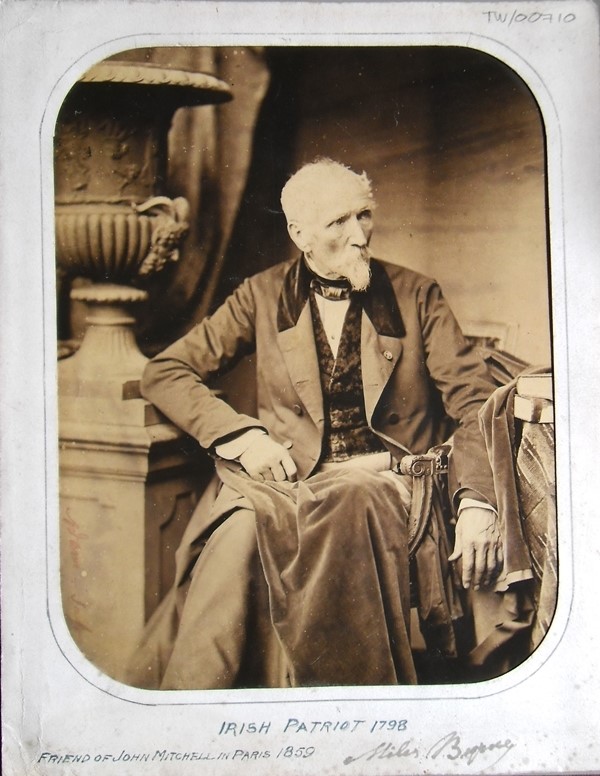
The photograph of Byrne, taken in 1859 (and recently colourised), is possibly the only one of a United Irish veteran and is now in Áras an Uachtaráin, the residence of the President of Ireland, in Dublin.