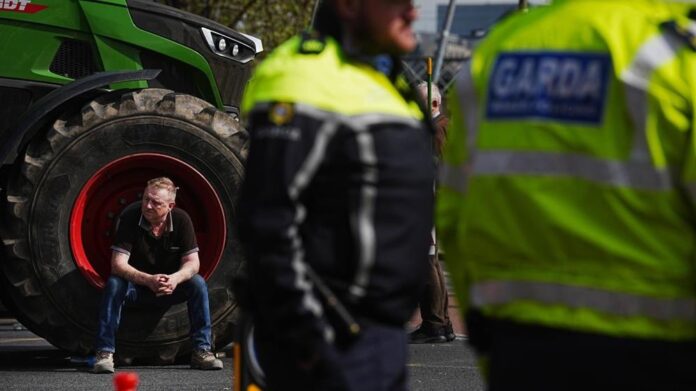
While the Polish government have reduced the price of petrol and diesel by 50% Mickey Mouse Martin Irelands Taoiseach won’t even meet the fuel protestors whose very livelihoods are threatened by the exorbitant increases in fuel prices. He can’t face up to the problem or face the people protesting. He just demonises them as “Far Right agitator’s” and is now threatening to call out the army to break up the protestors blockade. He is acting like “The boy who cried wolf”. He and his government have played that hackneyed old card with the Irish people for far too long. Sure he can call out the army, have protestors arrested and made martyrs of like any totalitarian regime that’s bankrupt of reality. That won’t solve anything but it will make the situation much worse. That’s the best an inept Taoiseach and his freeloading, name calling government can do.
The Army’s Role
Ireland’s Defence Forces (The Army is the land component) have a clearly defined role in domestic situations such as Martin has in mind. They cannot act as a police force. An Garda Síochána (the Gardaí) has primary responsibility for law and order and or internal security. He will use them to arrest protestors and make the situation worse.
The main legal and operational framework for deploying the Army on the streets or in public is through “Aid to the Civil Power” (ATCP), commonly called Aid to the Civil Authority. This is a longstanding role, rooted in the Defence Act 1954 (and related legislation), where the military assists civilian authorities but only when requested.
Key Circumstances for Army Deployment
The Defence Forces can be deployed domestically in the following main scenarios:
- Support for An Garda Síochána (ATCP): At the request of the Gardaí, for tasks where police resources are insufficient or specialist military support is needed. Examples include:
- Escorting high-risk prisoners or large cash/transfers (e.g., euro cash or explosives).
- Explosive ordnance disposal (EOD/bomb disposal) — a very common routine task.
- Protecting critical infrastructure or providing armed security at sensitive sites (e.g., airports like Shannon in the past).
- Dealing with serious public order incidents, blockades, or major disturbances where Gardaí request backup.
- Protection of critical national infrastructure or during major protests/blockades: For instance, in cases of widespread protests blocking roads, fuel depots, or other essential services, the government (via the Minister for Justice or Defence) can authorise military assistance to clear obstructions or support Gardaí in restoring access. This has occurred recently with fuel protests.
- Emergency or disaster relief (Aid to the Civil Authority — ATCA): During severe weather events (floods, snow/ice), pandemics, or other crises, the Army provides manpower, vehicles, and logistics to support local authorities, the HSE (health service), or emergency services. This is more about practical help (e.g., sandbagging, clearing roads) than “policing” streets.
- National emergency or armed threat: In extreme cases involving armed aggression, serious internal subversion, or a declared emergency under the Defence Act, the government can mobilise the Defence Forces (including calling up reservists) more broadly. However, even then, the military typically operates in support of the Gardaí rather than taking over law enforcement. Ireland has strong constitutional safeguards against martial law or unchecked military power on the streets.
Important Limitations of Army Deployment
The Army cannot deploy itself unilaterally. Deployment requires a formal request from the civil authorities usually the Gardaí, routed through the Department of Defence or the government. They have no power of arrest.
When deployed for ATCP, soldiers generally operate under the direction/supervision of the Gardaí and remain subject to both military law and ordinary civil/criminal law.
The Army’s Limitations
Routine “patrolling the streets” like a police force does not happen. Visible military presence is usually limited, targeted, and temporary (e.g., escorts, security details, or specific operations). Training exercises or routine movements sometimes create the appearance of deployment but are unrelated to public order.
Ireland’s tradition of military neutrality and strong civil control over the armed forces emphasises that the Defence Forces exist primarily to defend the state against external aggression, with domestic roles being secondary and supportive.
Policing Support Role
In practice, the Army has been used sparingly on the streets in a policing-support role since the Troubles era (mostly for border-related or security tasks). Large-scale deployment for riot control or widespread disorder would be highly unusual and would require clear government authorisation.
For the most authoritative details, refer to the official Defence Forces website (military.ie) or the Defence Act 1954. Specific deployments are decided case-by-case by the government.
Key Historical Deployments and Roles (1969 onwards)
1969 Crisis Response:
- Following the outbreak of severe violence in Northern Ireland (e.g., the Battle of the Bogside and riots in Belfast/Derry in August 1969), the Irish government under Taoiseach Jack Lynch mobilised elements of the Army.
- Three infantry groups (totalling around 795 personnel, including combat soldiers, support troops, and nurses) were deployed to the border regions, particularly in County Donegal near Derry.
- Field hospitals were established near the border to treat potential casualties or refugees.
- Refugee camps were set up in the Republic (e.g., at Gormanston Camp) for people fleeing the violence.
- Secret contingency plans (known as Exercise Armageddon) were drawn up for a possible limited humanitarian intervention across the border in “doomsday” scenarios, such as a complete breakdown of order in nationalist areas. These plans were ultimately rejected as militarily unsound and never implemented.
- Border Security and Internal Security Operations (1970s–1990s):
- This became the most sustained role. The Army established or reinforced ten military posts along the border.
- New infantry battalions and a cavalry squadron were activated specifically for border duties.
- Tasks included: armed border patrols, vehicle checkpoints, observation posts, and support for Gardaí in countering cross-border IRA activity, smuggling, or arms movements.
- The Reserve (FCA – Fórsa Cosanta Áitiúil) played a significant part in these internal security tasks.
- Emphasis shifted heavily toward Aid to the Civil Power operations, including explosive ordnance disposal (EOD/bomb disposal) and protecting key infrastructure.
Specific Incidents Involving the Irish Army:
In 1976, the Flagstaff Hill incident saw Irish Army soldiers and Gardaí arrest eight British SAS soldiers who had crossed illegally into County Louth in the Republic. The Army supported the checkpoint and demanded the surrender of explosives.
Routine support for Gardaí in border counties (e.g., Louth, Monaghan, Cavan, Donegal, Leitrim) against paramilitary threats from both republican and loyalist groups.
The Army occasionally provided security at sensitive sites or during major public events, but visible “troops on the streets” in cities like Dublin or Cork remained extremely rare and temporary.
Important Context and Limitations
The Irish Army’s role was defensive and supportive within the Republic. It focused on preventing spillover of violence, securing the border, and backing the police — not confronting civilians or acting as an occupying force.
There were occasional tensions or minor standoffs with British forces near the border, but no large-scale clashes between the two armies.
The Defence Forces suffered very low casualties during the period (one soldier killed in total, according to some records), reflecting their more peripheral role compared to the heavy losses sustained by the British Army, RUC, and paramilitaries.
Politically sensitive episodes, such as the 1970 Arms Crisis (involving attempts by some ministers to import weapons for Northern nationalists), highlighted divisions within the Republic’s government, but the Army itself remained under civilian control and loyal to the state.
In summary
While the British Army became a highly visible (and controversial) presence on Northern Ireland’s streets for nearly 40 years, the Irish Army’s “Troubles-era” deployments were concentrated on the border, involved support roles for the Gardaí, and were framed as protecting the Republic’s sovereignty and aiding civil authorities. Large-scale street deployments inside the Republic for public order never occurred.
For deeper reading, the official Defence Forces history on military.ie and declassified government documents from the period provide the most reliable accounts.