
Part 2 of a 3-part series by Tomas O’Riain
Marino and Ballymun represent two radically different housing models for rehousing Dublin’s tenement dwellers. Marino became one of Ireland’s most celebrated social housing schemes, while Ballymun’s towers were demolished in the 1990s–2000s as Europe’s largest urban regeneration project.
Architecture and Design
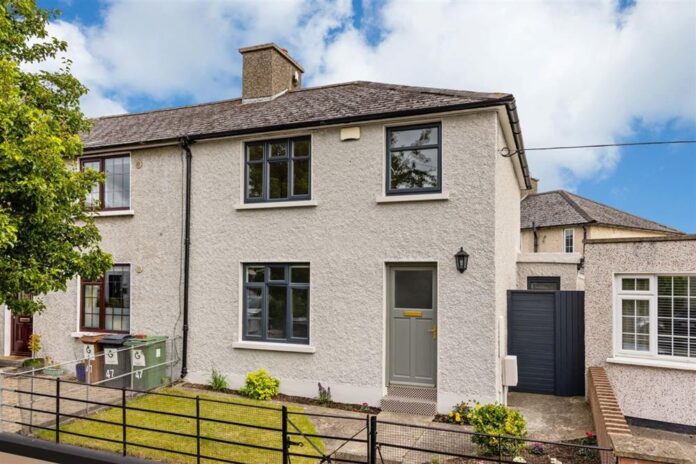
Marino (1924–1929) Garden suburb movement with an English influence, inspired by Hampstead and Bedford Park, London. It’s low-density geometric layout with varied house styles grouped around open green areas and cul-de-sacs typically with 12 houses per acre and substantial open space. The houses were built with concrete – unusual in Ireland at that time and considered ahead of its time.
The Marino project consisted of five-roomed houses (almost 1,300 total). The house type consisted of, “Parlour type”: living room, parlour, scullery, larder, bathroom, 3 bedrooms, WC, coal cellar. Each house also had a front garden (14 ft/4m), a back garden (150 ft/46m average) for vegetable growing. It also had recreational Space. Marino Park (football pitches, changing rooms), Croydon Park (tennis court, pavilion). It was ideally located within a few minutes of the City Centre on one side and Clontarf Promenade on the other.
Marino Financing & Ownership Model
Marino was a “Million-pound scheme” – with superior dwellings for their time and still structurally sound a century later. The houses were not for rent – but were sold through ” a tenant purchase scheme” priced from £400–£440 per house (1925) with no deposit required they could be repaid over 40-years at 5% per annum. The majority of occupants became owners by 1930–1968 via the tenant purchase scheme.
Rationale
Selling reduced ongoing costs for Dublin Corporation and resulted in “greater civic spirit” from home ownership. Only better-off workers with stable incomes could afford them. Poorest tenement dwellers couldn’t access directly but could wait for rooms vacated by families moving to Marino to become available for rent.
Marino’s Long Term Viability
Marino has been heralded as successful garden suburb design and has became one of the most celebrated social housing schemes in Ireland. Many of the original families still live there – many are descendants of the original purchasers. They have proved to be quality, comfortable housing for many families over the decades becoming a diverse community consisting of different ages and backgrounds with a community spirit for which Marino has always been famous.
Ballymun Towers (1966–1969)
This complex consisted of Seven towers, named after the seven 1916 Rising leaders: Pearse, MacDonagh, Clarke, Connolly, Ceannt, Plunkett, McDermott. Each block consisted of 15 storeys tall, 90 flats per tower, 6 per floor of a “Brutalist” modern design or “paean to modernism”. Its extremely high density – was designed to address the severe 1960s housing crisis. It was built with precast walls and in-situ concrete floors (French Balency et Schuhl system) avoiding complex joints. Each flat or apartment was larger than average Dublin Corporation house; with underfloor central heating provided by district heating system consisting of floor-slab heating coils, electric wiring, mechanical ventilation ducts. All apartments had constant running hot water, central heating, and flush toilets. Its lifts – “delighted” families especially the children when they first arrived. It seemed idyllic on paper.
A Disaster in the Making
Soon they were breaking down and so was everything else. On paper it was a marvel. In reality it was a brutal disaster as its architectural design suggested. The towers were demolished 1997–2018. They were originally designed to house young families with high unemployment, low education and social problems. Broken lifts, bad insulation and poorly maintained was the order of the day. Poor planning resulted in the absence of amenities, shops, recreation, green spaces – people were isolated with nowhere to go. This led to Crime and drug addiction. Open land between blocks became foreboding and dangerous after dark. Ballymun had a poor image and had a run-down appearance resulting from decades of neglect by the 1990s. It was a failed and a disastrous project from the beginning and was never suitable to the Irish environment.
Ballymun
Dublin Corporation (state) built flats for social housing rent, not for sale. They were built as a “quick fix” – with no tenant purchase model.
Rationale
Fast rehousing of large numbers of young families from inner-city tenements
Why Such Different Outcomes between Marino and Ballymun?
Marino’s Success Factors
- Garden suburb principles: Low density, greenbelts, open space, culs-de-sac
- Home ownership: Tenant purchase created “civic spirit” and reduced Corporation costs
- Gardens: Agricultural background expected, vegetable growing space
- Amenities built in: Parks, football pitches, tennis courts from start
- Quality construction: Concrete considered “ahead of its time”
- Better-off workers: Only stable-income families could afford – not poorest
- Close to City Centre on one side and Clontarf promenade on the other.
Ballymun’s Failure Factors
- High density without amenities: “No infrastructure development” – isolated
- Social housing only: No ownership, no civic investment
- No gardens: Flat blocks, no green space for residents
- Poor maintenance: Broken lifts, bad insulation, deteriorating concrete
- Social problems: High unemployment, low education, crime, drugs
- Brutalist design: “Not suitable to Irish environment” – modernism failed
- Quick fix: Built as “quick fix for social housing needs”
Legacy and Regeneration
Marino
- Celebrated model – what Dublin Corporation could achieve
- Original families still live there – community spirit continues
- Sought-after locality – high property values
Ballymun
- Europe’s largest urban regeneration (1997–2018)
- Demolished 36 blocks, 2,820 flats (including 7 towers)
- Rebuilt 5,000 new homes (2,000 social, 1,350 private apartments)
- Added community facilities, parks, town centre, jobs, improved transport/security
- 2025: Almost 300 new social homes on leftover regeneration land
- Learning from failure: “Decisions of the past simply weren’t suitable to the Irish environment”
CONCLUSION
Marino and Ballymun represent two fundamentally different approaches to rehousing Dublin’s tenement dwellers:
Marino (1920s garden suburb) succeeded because it provided low-density houses with gardens, amenities from the start, and home ownership – creating a stable, proud community that still thrives today.
Ballymun (1960s high-rise) failed because it provided high-density towers without amenities, no ownership, poor maintenance, and unsuitable modernist design – creating isolation, social problems, and ultimately requiring Europe’s largest demolition project.
The lesson: low-density garden suburb housing with ownership and amenities proved far more viable than high-density brutalist towers without infrastructure.