
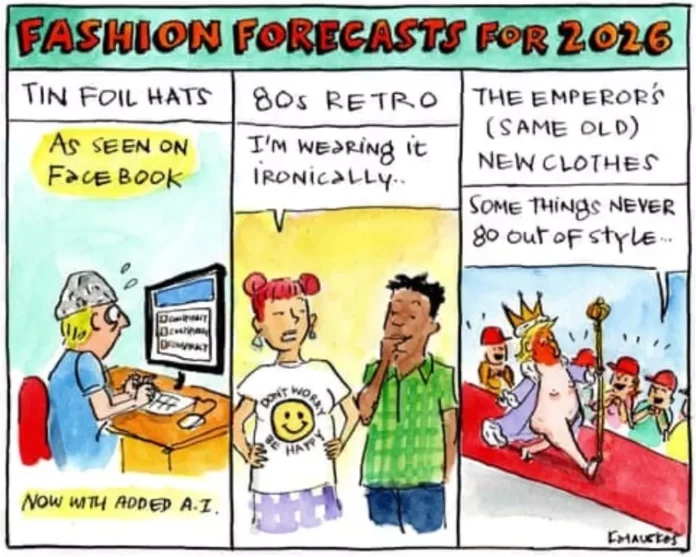
Ireland’s first National Textile Strategy is formally known as the National Policy Statement and Roadmap on Circular Textiles (2026–2028). This was published in April 2026 by the Department of Climate, Energy and the Environment. This looks innocuous and even beneficial at first glance. This is the first tentative step in telling you what you can buy, what you can wear and what you can’t. According to the official Irish Government website, the campaign encourages people to:
- Think carefully about whether you really need to buy new clothes.
- Wear your clothes more often.
- Borrow and swap clothes with friends and family.
- Repair clothing instead of throwing it away.
- Donate clothes that you no longer wear.
Minister Alan Dillon stated that too many clothes are being thrown away, and that the goal is to keep clothing in use for as long as possible. Take note girls, you are wearing a carbon footprint. What’s Next – A Carbon Tax on Clothes?
The Boiling Frog Strategy
The EU and the Irish government are operating on the boiling frog strategy. If you put a frog in boiling water, it will immediately jump out to escape the danger but if you put a frog in cold or tepid water and slowly heat it up, the frog won’t perceive the gradual change and will stay in the water until it boils to death. The frog’s survival instincts are geared toward detecting sudden changes, not gradual ones. The story is used as a metaphor for human psychology that governments use of it to impose all kinds of restrictions and taxes. For example, when the Irish government first imposed what was then known as turnover tax now VAT. It was set at two and a half percent and they promised it would remain at that. Governments lie and it is now 23%.
Textiles to Cars
The governments frog boiling strategy will move from textiles to vehicle, to god knows what. They are already thinking of purchase restrictions or quotas on cars to manage traffic. This may require lottery systems or license plate controls, However, back to fun and games with textiles. This EU pushed policy being implemented by Ireland is designed to reach the stage where the girls will have to wear the same old dress to nightclubs, weddings and everywhere else. If they want to buy a new outfit, they will have to follow the government and EU regulations on the disposal of the old one and justify the reason for a new one. Then they will be required to fill up a form to get a government voucher to enable them to buy a new one. That will be such fun. Will the drug barons move into the textile industry selling illicit dresses and knickers to vain young things who want another new outfit but are not entitled to ‘a government purchase voucher’? Maybe carbon neutral nudism is next on the EU agenda.
The Girls Will Be Screaming
While the girls are screaming for government ministers blood, the government will explain that their justification is that Ireland has among the highest textile consumption rates in the EU, with the average Irish citizen consuming 53kg of textile products annually. The textiles industry encourages this by operating in a linear “take-make-waste” model that creates major environmental challenges so clothing restrictions are on the way. Will that include unnecessary apparel like hijabs? Or will all women be expected to wear hijabs, so there’ll be no need to produce a variety of colorful fabrics—just that one single garment? Just asking.
The government strategy aims to:
- Move Ireland closer to a circular economy for textiles
- Reduce excessive production and consumption
- Promote reuse and repair priorities
- Make the fashion/textile industry more responsible for the waste it produces
The stated aim is to support and implement EU sustainability regulations which means it is EU agenda. And the the Irish government always follow all EU agendas ‘lap dog’ style. Believe it or not this is a key pillar of Ireland’s climate action agenda. The government thinks you are destroying the climate girls. It’s all hot stuff and you are wearing it.
Government Website Advice
The government has some advice for you on its website. It tells you “Daunting as it may seem, with a little help you can give this a try – sewing classes are available across Ireland and online and many of these are aimed at making minor repairs to keep the items you love in use for longer. You can also find a directory of repair services on the Repair My Stuff website.
Vintage, thrifting and buying pre-loved are really on trend right now. Check out your local charity shops, vintage stores, or online to find something unique, or even get your hands on a piece that you missed out on recently.”
Yes, I can just see all the fashion conscious young things following that advice. What do you think?