“The Bansha Peeler” — much more commonly known as “The Peeler and the Goat” — is one of Ireland’s most famous and enduring satirical ballads. Written in the 1830s, it’s a brilliant piece of political mockery that disguises a sharp critique of British colonial policing and corruption as a ridiculous argument between an overzealous policeman and a farm animal.
The Plot of the Song
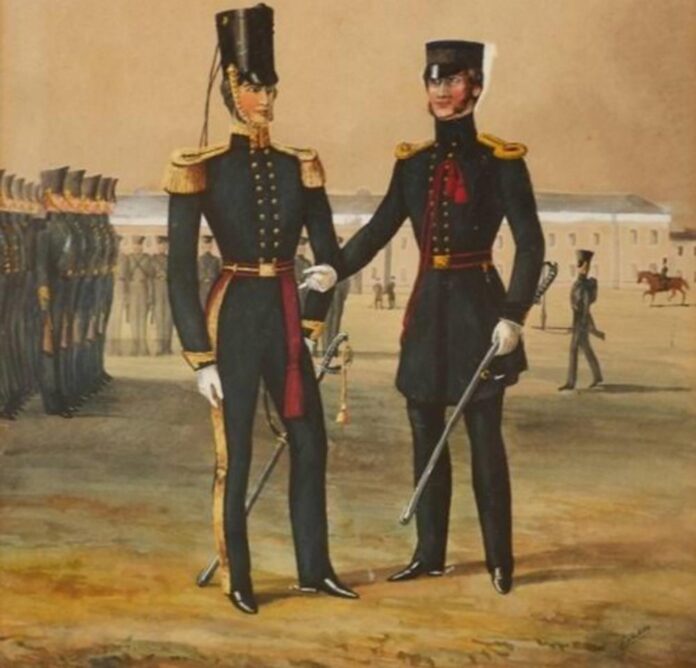
The song recounts a fictional (but historically resonant) encounter in the village of Bansha, County Tipperary. A “Peeler” — a nickname for the officers of the newly formed Royal Irish Constabulary (RIC), named after their founder, Sir Robert Peel — is out on night patrol. He comes across a she-goat known locally as a Ginny Goat wandering the road and decides to arrest her for being “disorderly and idle” (loitering). He threatens to have her sent to Cashel to be convicted and ultimately transported to a penal colony in Australia. Instead of going quietly, the goat argues back. What follows is a witty courtroom-style exchange in the middle of the road:
- The Goat’s Defence: She points out she has broken no laws (“No penal laws did I transgress / By deed or combination oh!”), arguing that she is simply a native of Bansha minding her own business.
- The Peeler’s Arrogance: The policeman ignores her logic, threatening to handcuff her and make an example of her to show off his power.
- The Goat’s Verdict: In the final verses, the goat turns the tables. She accuses the Peeler of being drunk on whiskey and exposes his corruption, pointing out that if she had a bribe of money or poteen (illegal liquor) to offer him, he would gladly let her go.
The Symbolism
The song was an immediate hit because the Irish public instantly understood the underlying metaphor:
| The Goat | Represents the impoverished, oppressed Irish Catholic population. The fact that she is female also allows the Peeler to frame her loitering as prostitution, a common excuse used to arrest the vulnerable. |
| The Peeler | Represents the heavy-handed, often absurd, and corrupt nature of British colonial law enforcement. The RIC was supposed to be a professional, incorruptible force, but Ryan’s song skewers them as petty tyrants who harassed locals while looking for bribes. |
The song became so subversive and widely recognized that, during certain periods of British rule, reportedly even whistling the melody of “The Peeler and the Goat” derisively at an officer could land a person in jail under the Defence of the Realm Act. The song became immensely popular and spread worldwide through the Irish diaspora. It is still widely sung today by Irish balladeers and there are numerous recordings of it.
The Author: Darby Ryan
The man behind the wit was Darby Ryan (born Diarmuid Ó Riain, 1777–1855), a bilingual bard, farmer, and hedge-school master from Ashgrove, just outside the village of Bansha in County Tipperary. Ryan lived through some of the most tumultuous periods in Irish history, including the 1798 Rebellion, the fight for Catholic Emancipation, the Tithe Wars, and the Great Famine. He used his poetry to document the woes of the Irish people and to poke fun at the establishment.
He was educated within Ireland through the hedge school system — the informal, often underground network of rural Catholic education. He went on to become a hedge school master himself in the Bansha area. His high level of literacy and fluency in both English and Irish, as well as the classical structures found in his poetry, were hallmarks of the surprisingly rigorous education many hedge schools provided locally.
He wrote fluently in both English and Irish, and whenever an event of local or national importance took place, Ryan was often called upon to immortalize it in verse. While he wrote many poems (eventually collected in a volume called The Tipperary Minstrel), “The Peeler and the Goat” remains his undisputed masterpiece, carried across the world by Irish emigrants and still sung by traditional musicians like The
Ryan is buried in the old Templeneiry graveyard in his native Bansha, where a carved stone cross with an anchor breast piece which is clearly visible today marks the resting place of the village’s most famous bard.
A Classic Bilingual Bard
Darby Ryan was a classic bilingual bard, meaning he composed fluently in both English and Irish (Gaeilge). Because he served as a local “hedge school” master — an educator in the informal, often illegal Catholic schools of the era — he was highly literate and deeply plugged into the grievances of the rural poor who were the Irish dispossessed of their land, forbidden an education, to own land or to own a business. While much of his work was hyper-local, a few of his compositions survived the centuries. Here are the most notable examples of his other surviving works and what they targeted:
“The Galbally Farmer”
Outside of “The Peeler and the Goat,” this is Ryan’s most famous English-language ballad. It is still occasionally sung today by traditional musicians. It mocked exploitative farmers who took advantage of desperate itinerant laborers known in Ireland as spailpíns. The song is a comedic but bitter diatribe narrated by a hired farmhand who goes to work for a notoriously stingy farmer named Darby O’Leary in Galbally a village right on the Limerick/Tipperary border. The narrator details the atrocious, backbreaking working conditions and the watery, inedible slop he is given for food. Though it highlights genuine rural poverty and worker exploitation, Ryan delivers the protest through hilarious, savage exaggeration, effectively ruining the reputation of any farmer who acted like “O’Leary.”
The Mock “Warrant” (Barántas)
Ryan was highly respected for his Irish-language poetry, with scholars noting his mastery of a specific comedic genre known as the Barántas (Warrant). It mocked local characters, rivalries, and the pompous legal language of the British courts. In 18th and 19th-century Munster, Irish poets would draft mock-legal “arrest warrants” in highly stylized, dramatic poetry. They would “prosecute” a neighbour, friend, or rival for a trivial, absurd, or completely fabricated offense. Ryan wrote a famous one titled “Barántas ar Chionntughadh Thaidhg Finín Mhac Cárthaigh” (A Warrant for the Conviction of Tadhg Finín Mac Cárthaigh), which scholars consider a masterpiece of sarcasm, exaggeration, and wit.
Lyrical Irish Poetry
Not all of his work was satirical; Ryan also wrote traditional, lyrical poetry that celebrated his local landscape. The most famous of these is “Aréir cois taobh na hEatharla” (Last Night Beside the Aherlow), a beautiful piece named after the River Aherlow that flowed near his home in Ashgrove.
Other recorded Irish-language titles of his include “An Dair Chumhra” (The Fragrant Oak) and “An Chuilith Éadaigh” (The Suit of Clothes). Because Ryan’s poems were often passed around orally or on cheap single-sheet prints called broadsides, his complete works were never formally published during his lifetime. However, in 1861 — a few years after his death — a small, inexpensive booklet called a chapbook was printed in Dublin. Titled The Tipperary Minstrel, it collected 15 of his English-language songs and poems together, ensuring that the “Bard of Ashgrove” wouldn’t be forgotten by history.
Get a Copy
Is it possible to get a copy of “The Tipperary Minstrel” today? You don’t need to track down a fragile, 160-year-old antique to read it today. While original 1861 chapbooks are incredibly rare and usually confined to university archives or private collections, the text has been preserved and is easily accessible.
Here are the two best ways to get your hands on a copy today:
- Buy a Modern Paperback Reprint
The British Library holds an original 1861 copy of the chapbook in its archives. Through their “Historical Print Editions” program, they have scanned the original pages and made them available as a modern, print-on-demand paperback.
Because it’s print-on-demand, it is still actively printed today. You can easily order it through major online booksellers (like Amazon, eBay, or Walmart) or ask an independent bookstore to order it for you. If you are searching for it, use these exact details:
- Title: The Tipperary Minstrel: Being a Collection of the Songs Written by the Late J. O’Ryan, Comonly (sic) Known as Darby Ryan
eBay UK
- Publisher: British Library, Historical Print Editions
Walmart
- ISBN-13: 978-1241415433
Walmart
- Format: Paperback (approx. 50 pages)
View it in Digital Archives
Because the work is long out of copyright and resides in the public domain, it has been preserved by various academic digitization projects. If you just want to read the poems rather than own a physical book, you can often find digital scans of the original text through academic portals like the British Library’s online catalog or sometimes scattered through the Internet Archive. Additionally, Irish traditional music archives (like the ITMA) hold records and broadside scans of specific songs from the collection, like The Peeler and the Goat.