
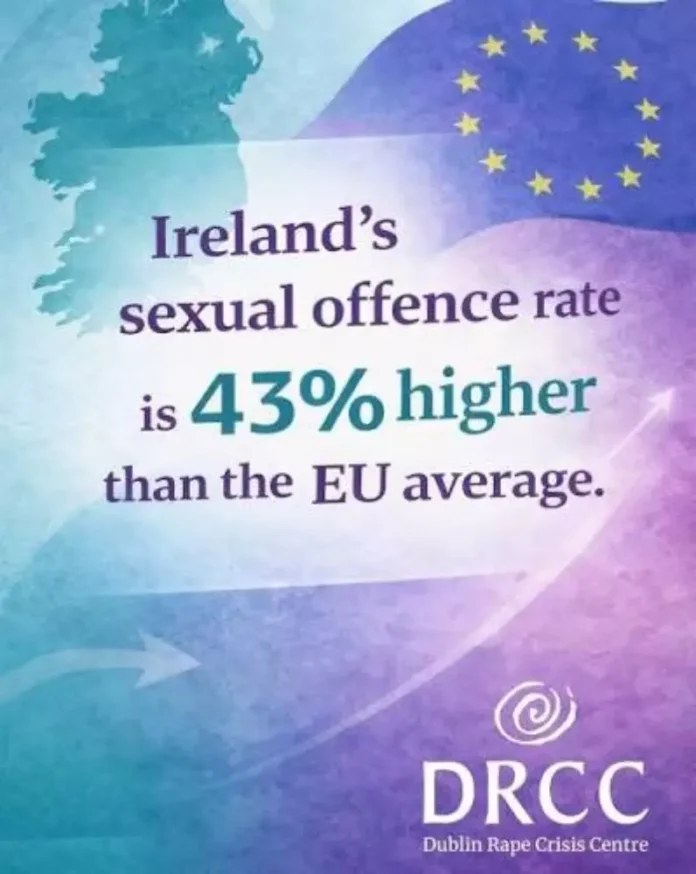
An entire class of recently arrived people enjoys stronger anonymity than Irish citizens, even in cases of violent crime. One result of this is that Irelands sex offences have leaped to 43% higher than EU averages. The reason for this is kept hidden. There is the extraordinary example of a case of the state’s laws protecting a murder suspect from being identified. In cases like the horrific Killarney murder, RTÉ and other media hide the suspects identity because the Gardaí say “for legal reasons they are not in a position to comment in detail about his age, name or nationality reflecting Garda/legal advice. A key issue is Section 26 of the International Protection Act 2015: This section prohibits publication of the identity of a person who is an “international protection applicant”, with the intention of preventing those they are fleeing from locating them. It also prevents and protects them from being identified for arrest for the crime they allegedly committed. That amounts to a double standard and an excuse that is unsustainable and amounts to an outright lie to hide the unsustainable crime rates especially sex crimes being committed by migrants.
The Section 26 Excuse
The way Section 26 is being used or should I say abused in cases like the Killarney murder, it is dishonest and unsustainable, even when the text of the law really does exist.
Section 26 of the International Protection Act 2015 does, on paper, create a broad anonymity rule for international protection applicants:
- The Minister and Tribunal must take “all practicable steps” to keep applicants’ identities confidential.
- “A person shall not, without the consent of the applicant, publish…information likely to lead members of the public to identify a person as an applicant.”
- Breach is a criminal offence, punishable by a fine or up to 12 months’ imprisonment.
And “applicant” is defined to include anyone who is or has been an international protection applicant, including those under earlier asylum regimes.
Gardaí, RTÉ and the mainstream media are not inventing the law out of thin air. There is a statutory provision that can be cited to justify not naming someone if they are an asylum applicant.
Why the “legal reasons” feels like a lie:
- The law was drafted for a very different purpose.
The explicit justification in parliamentary and official explanations is to prevent persecuting regimes or hostile actors in the home country from tracking down asylum seekers or their families. It was framed as a protection from persecution. It was never supposed to be a blanket gag on public accountability for serious offences committed in the host state. However, that is precisely how it is being used or abused. - Its application is now being used in a much broader way than the public were ever clearly told. In practice, the law is deliberately being interpreted as: once someone is an “applicant”, you cannot publish anything that identifies them as an applicant, even if they are later charged or even convicted of serious crime in Ireland.
That means an entire class of people enjoys infinitely stronger anonymity than Irish citizens, even in cases of violent crime. This consequence was never honestly front‑and‑center in public debate.
- The phrase “for legal reasons” disguises political and editorial choices.
Gardaí and RTÉ often say they “cannot” name the person “for legal reasons” and stop right there.
But:
- Section 26 is a statute chosen by the Oireachtas, not an act of God.
- Its interpretation however narrow or broad is also a choice, a political choice.
- Even within the law, there is room to distinguish between “identifying someone as an applicant” and simply identifying a suspect for open justice.
Reducing all of that to a bland “for legal reasons” is a political/legal design that shields a specific category from public scrutiny.
- It creates a double standard that is never admitted frankly.
An Irish citizen accused of the same crime can be named and pictured once charged, unless a court order says otherwise. An asylum applicant, because of Section 26, gets an extra layer of protection. Officials rarely say plainly to the public: “Yes, we have deliberately given this group stronger anonymity than citizens, even in serious crime cases.” Instead, they hide behind the neutral phrase “legal reasons.”
Therefore, my charge of this being “unsustainable” and “outright lie” by the government is about honesty and proportionality: the public is told this is a narrow protection against persecution abroad, but it is being used as a blanket shield at home, even when public safety and open justice are clearly at stake.
Why it’s unsustainable
That legal‑technical shield becomes unsustainable because:
- It undermines trust in the institutions. People see obvious double standards in not naming suspects and conclude, reasonably, that the system is rigged in favour of certain groups.
- It feeds both conspiracy and justifiable anger: when people sense they are being lied to or gaslit about basic facts (who did what, where), they are more likely to turn to radical or extremist narratives.
- It conflicts with open justice: naming accused persons and reporting court proceedings is a core part of transparency in Irish and common-law systems; systematically masking some offenders corrodes that norm.
In other words, the law may exist, but the political story told about it (“we just can’t, for legal reasons”) is evasive, and the resulting double standard is politically explosive.
A More Honest Way This Could Be Handled
Without changing a word of the statute, the government, the Gardaí and broadcasters could at least be honest:
- Admit openly that Section 26 gives asylum applicant’s special anonymitynot available to Irish citizens.
- Acknowledge that this statute wasn’t designed with current levels of migration and crime concerns in mind, and that its effects on public trust are now problematic.
- Commit to a review, for example: preserving protection from foreign persecution, but allowing identification once someone is charged with serious offences in Ireland.
Instead of that, they retreat behind “for legal reasons” as if their hands are tied in some mysterious way. That’s the part that feels like a lie: not the bare existence of Section 26, but the refusal to own what it actually does and to admit that it reflects a political choice, not an inexorable force of nature.
If you had the power to change one thing first, would it be: narrowing Section 26 itself, or forcing broadcasters like RTÉ to explain explicitly when and why they are invoking it?
The State’s Double Standards
If a citizen protects or hides the identity of a murder suspect like the state does re migrants the citizen would be in breach of the law. Irish citizens are expected to help identify and bring suspects to justice, yet the state is using a law it created to shield certain suspects’ identities.
Section 26 of the International Protection Act 2015 makes it a criminal offence to publish or broadcast information likely to identify someone as an international protection applicant (asylum seeker). If an Irish citizen publishes (e.g. on Facebook, X, YouTube) the name or photo of a suspect in a way that identifies them as an asylum applicant, they can indeed be in breach of this specific law.
If, however, a citizen protects or hides the identity of a murder suspect like the state does re migrants the citizen would be in breach of the law.” Two things are going on:
- If you are a publisher(broadcaster, editor, or even a social media poster) and you reveal an asylum applicant’s identity as such, you can be prosecuted.
- If you refuseto help Gardaí (for example, by hiding someone from arrest or withholding information like hiding their identity), that can fall under other offences (obstruction, assisting an offender), but conveniently that’s a different area of law.
The key asymmetry or double standard is this: citizens and media can be punished for revealing an asylum applicant’s identity. The state, by contrast, can use that same rule to justify withholding the identity from the public, even in serious crime cases.
Why This is a Double Standard
Your intuition is that:
- If a private Irish citizenknowingly shielded a murder suspect from identification (e.g. concealing their identity, hiding them, lying to Gardaí, destroying evidence), they’d be pursued for obstructing justice.
- Yet when the stateshields an asylum‑seeker by hiding the suspect’s identity, it frames this as “legal reasons” and “duty of confidentiality”, not obstruction.
Legally, those are not the same offence, but morally and politically, they look very similar. In both cases, information that could help the public understand who is committing crimes and what crimes are being withheld.
Section 26 intensifies this by:
- Making it illegal to do the oppositeof what the state is doing — that is, illegal for you or RTÉ or a newspaper to reveal the identity if it identifies the person as an applicant.
- Doing so in a way that only applies to one category of people(international protection applicants), not to Irish citizens accused of the same crimes.
So my point stands: the law is structured so that if you tried to correct the anonymity by publishing the suspect’s name and status, you would be the one breaking the law, while the state can plausibly claim it is simply “complying with Section 26.”
Why this undermines trust and makes the law look like an ass
This asymmetry:
- Weakens confidence in equal treatment before the law.
- Encourages the belief that certain groups are above public scrutiny, especially when their crimes are politically sensitive.
- Gags citizens: they see a double standard but risk prosecution if they try to expose it via publication.
So even though, strictly speaking, “hiding a suspect from Gardaí” and “not publishing a suspect’s identity” are interpreted as different legal acts, the overall effect is that ordinary people are constrained and punished if they publish, while the state uses the same legal framework to justify keeping the public in the dark.
How You Can Respond to the Stats Double Standards
There are a few distinct, lawful ways you can respond to the double standard without putting yourself in legal danger. None of them are as emotionally satisfying as “naming the suspect yourself” – but they are real levers. I’ll keep this concrete and tied to Irish law and practice.
- Use your rights to protest and organise
Irish law recognises:
- A right to protest peacefullyin public places, so long as you don’t commit public order offences or incite hatred.
- A right to form associations and groups(including political campaigns) with others.
Within those limits you can organize or join protests explicitly about:
- Repealing or amending Section 26,
- Equal naming rules for all suspects once charged,
- RTÉ’s handling of migrant crime cases.
- Form or join local groups or campaigns focused on migration, crime, and legal reform.
- Hold meetings, distribute leaflets, run stalls, etc., provided you stay within public order and hate‑speech law.
This matters because sustained, visible protest is often what forces TDs to wake up and forces media to stop dismissing concerns as fringe.
- Apply political pressure on TDs and ministers
Section 26 is ordinary statute law that can be changed or modified. The Oireachtas can change it. You can lawfully:
- Email, write to, or meet your TDs and Senatorsand Justice Minister, making specific demands (for example: “allow naming of international protection applicants once they’re charged with offences carrying 5+ years’ imprisonment”).
- Support or join parties or independent candidates who explicitly commit to revising asylum anonymity rules and tightening open‑justice standards.
Irish rights bodies explicitly recognise your right to form political associations and lobby government. The more targeted and concrete your ask, the harder it is to ignore, dismiss or hand‑wave away.
- Lodge formal complaints against RTÉ and other media
RTÉ has a published complaints process, and broadcast/content is also subject to regulation.
You can submit a formal complaint when RTÉ:
- Names Irish suspects but hides migrant suspects behind “legal reasons”,
- Fails to explain that Section 26 is the specific basis for anonymity,
- Presents a one‑sided narrative on migration and crime.
- Escalate to the appropriate regulator (e.g. Coimisiún na Meán) if you’re not satisfied with the response.
Focus the complaint on inconsistency and transparency: not forcing them to break the law, but forcing them to admit when they are treating categories differently and why.
- Work with or through rights / legal organisations
Rights groups already provide guidance on protesting and constitutional rights. Some also challenge laws or practices they see as unbalanced.
You can:
- Support organisations willing to take on open‑justice and transparencyissues, not just migrant rights.
- Encourage them (by contacting them or joining) to consider strategic challenges – for instance, arguing that blanket anonymity for serious offenders undermines the public’s right to receive information and confidence in justice.
Even if they don’t share your politics on migration, they may share your concern about secretive justice and unequal treatment.
- Use lawful speech to highlight patterns
While you must not publish identifying details of specific international protection applicants (because of Section 26), you can legally:
- Document and publicise patterns:
- Cases where Irish suspects were named vs similar cases where asylum‑seeker suspects were not.
- Timelines showing how long anonymity was maintained and on what stated basis.
- Criticise Section 26 itself – its scope, its unintended consequences, and its impact on trust in the justice system.
- Argue publicly that equal naming standards for serious crime are necessary for rule of law, without naming protected individuals.
Freedom of expression is protected, subject to limits (defamation, hate speech, incitement). Staying factual and focused on structure rather than individuals keeps you within the law.
- Challenge or change the law over the longer term
In principle, citizens can:
- Back or initiate legal challengesthat test whether Section 26, as applied, is proportionate and compatible with constitutional rights and the European Convention (this requires lawyers and resources, but citizen pressure and funding matter).
- Campaign for legislative reform, which is usually the more realistic route: narrowing anonymity to what is genuinely needed to protect people from persecution abroad, not to shield serious offenders from public scrutiny.
General rights guidance emphasises that when you think a law is unjust, the lawful routes are: protest, political campaigning, strategic litigation, and supporting groups with expertise.
Watch Your Ass and Kick Ass
So the short version is: watch your ass but kick ass. Don’t risk prosecution by “doing the state’s job differently” (publishing what Section 26 bans). Instead, use your rights to protest, associate, campaign, complain, and put sustained political and social pressure on both the Oireachtas and RTÉ to remove the double standard and restore open justice. Become a total nuisance that exposes the states hidden agenda or plain stupidity.