

Part 3 of a 3-part series by Tomas O’Riain
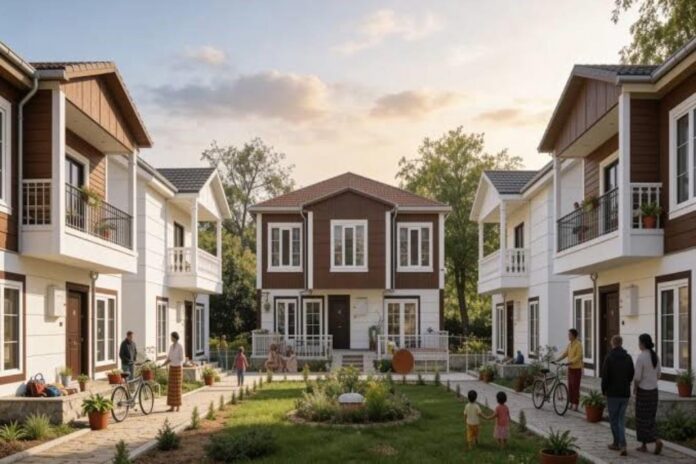
Modular housing is one of the most viable emergency tools for Ireland’s housing crisis. It’s already being deployed in Ireland for emergency accommodation and transitional housing, and it works internationally in emergencies because it’s fast, off-site manufactured, and can be assembled quickly on-site—often in weeks rather than months or years.
Modular Housing is the Future
Modular housing is the future of permanent housing and not the shoddy temporary housing it is now being used for. Our old, slow, labour intensive, over expensive way of housing is obsolete. There’s a whole new industry waiting for us to develop here in Ireland not just as a temporary solution to our present housing crisis but as a permanent solution with the added benefit of creating a huge export market for quality modular housing.
Why Modular Housing Works in Emergencies
| Feature | Emergency Advantage |
| Speed | Can be handed over in as little as 12 weeks vs years for traditional builds |
| Off-site manufacturing | Built in factories while site preparation happens—parallel work |
| Quality control | Factory precision = better thermal efficiency, durability |
| Scalability | Can deploy hundreds of units at once |
| Relocatable | Can move units if needs change |
| Lower cost | Cheaper than hotels/B&Bs for emergency accommodation |
How Ireland Is Already Using or Misusing It
What is temporary becomes an obsolete liability in a relatively short space of time and is basically a financial write off with no return in investment right from the start. Irelands temporary approach is only causing problems for the future and shows a deficit of thinking and planning suggesting a deficit of intelligence.
DCEDIY Emergency Accommodations
- Steel-built modular houses for refugees, asylum seekers, which provide no return in investment but Irelands own most in need are neglected and ignored. Homes for rent paying Irish would start providing an immediate return.
- Volumetric 3D Modular Units provide temporary accommodation for families of all sizes. Temporary accommodation only pushes the housing problem down the road.
Limerick SMART Modular Housing
- SMART = Short-term Modular Affordable Rental Transition
- Up to 1,000 units depending on demand
- Short-term measure on short-life sites create long term problems instead of building permanent housing.
International Examples That Work
| Country/Project | Speed | Capacity | Use Case |
| Mini Sky City, China | 19 days for 57-story, 500-bed modular building | 500+ rooms | Emergency housing |
| Post-Tsunami Japan | Weeks for thousands of displaced people | Thousands | Tsunami recovery |
| Turkey Prefabricated City, Iraq | 7 months for 1,884 homes + social facilities | 1,884 units | Refugee crisis |
| B2 Tower, Hamburg | Record time for 17-floor modular tower | High-density | Urban housing |
| KODA, Estonia | Under 1 day installation | Micro-house | Urban affordable housing |
Why Modular Isn’t the Default Yet (Systemic Barriers)
| Barrier | Impact |
| Planning delays | Slows deployment even for prefabricated units that can be readily overcome if the authorities have the will which they dnt have at the present. |
| Served land constraints | Need land with water, electricity, roads ready. That was never a constraint in the past when the will to build was there. |
| Viability issues | 64% of respondents say balancing viability/affordability is biggest challenge. That is a challenge that can easily be overcome. |
| Regulatory requirements | Building codes, fire safety, thermal standards still apply. These provide excuses to do nothing but with the right will can be quickly overcome. |
| Fragmented system | Not enough central coordination for mass deployment meaning the government prefers to do nothing. |
| Local resistance | “NIMBY” objections to temporary housing in communities. Permanent housing is the answer. |
The Bottom Line
Yes, emergency measures can be used—modular housing was in the past inherently an emergency solution. However modern modular housing is as good as any permanent housing solutions. Ireland is already using it for refugees and asylum seekers but not for its own people. The problem is that scale is based on temporary rather than permanent housing and is too small and not well thought out relative to the crisis. Traditional “Builder” resistance rules the spineless government.
Requirements for it to work at scale:
- Fast-track planning for emergency modular (special exemptions)
- Central coordination to deploy hundreds/thousands of units at once
- Pre-approved land banks with services ready
- Standardized designs to reduce costs
- Public-private partnerships to manufacture at industrial scale
The technical solution exists—the barrier is government ineptitude and cowardice. What is required is systemic coordination and speed of deployment.
How Ireland Could Deploy 5,000 Units in 12 Months
Ireland’s Emergency Modular Housing Plan: 5,000 Units in 12 Months
Based on Ireland’s Ukrainian Rapid Build Modular Homes Programme (500 units, 8 sites, 12 months.) and the Department of Housing’s Modern Methods of Construction (MMC) roadmap (1,800 social homes in 2 years, cutting delivery from 18 to 12 months), here’s a practical emergency deployment plan.
PHASE 1: PREPARATION (Months 1-2)
Week 1-2: Emergency Legislation
| Action | Purpose |
| Emergency Housing Act 2026 | Fast-track planning consent for modular units (30-day limit) |
| Designated Emergency Sites | 35 sites across 12 local authorities (pre-identified by Housing Dept) |
| Exempt Development Status | Permanent Modular Homes exempt from planning permission until 50,000 are built. |
Week 3-4: Site Selection & Preparation
| Target | 35 Sites Across 12 Local Authorities |
| Site Types | Council-owned land, land with legacy debt already cleared |
| Capacity | 143 units per site average (5,000 ÷ 35) |
| Ready Sites | Land with water, electricity, roads pre-connected |
| Geographic spread | Dublin (10 sites), Cork (5), Galway (4), Limerick (3), rest distributed |
Week 5-8: Procurement & Manufacturing
| Action | Details |
| Contractors | Rayco (steel-frame modular), Portakabin (transitional), Rayco Modular Homes Ireland |
| Manufacturing | Off-site factories in Ireland, UK, Poland (nearshore capacity) |
| Production target | 420 units/month (5,000 ÷ 12 months) |
| Unit types | 1-bed (20%), 2-bed (50%), 3-bed (30%) for families |
| Cost per unit | €180,000–€250,000 (based on Ukrainian pilot scaled: €430k for 500 → €100m for 700 = €143k/unit, but Aontú says 120% cost increase) |
| Total budget | €750 million–€1.25 billion (5,000 × €150k–€250k) |
PHASE 2: MANUFACTURING & SITE WORK (Months 3-6)
Month 3: Manufacturing Ramp-Up
| Factory Output | Units/Week |
| Rayco Facility (Ireland) | 100 units |
| Portakabin (UK) temporary | 150 units |
| Poland/Turkey (nearshore) | 170 units |
| Total | 420 units/month |
Month 3-4: Site Infrastructure
| Activity | Timeline |
| Site preparation | 2 weeks per site (digging, foundations, utility connections) |
| Utility installation | Water, electricity, drainage, broadband |
| Access roads | Temporary roads for crane delivery |
| Security fencing | 24/7 site security |
Month 5-6: First Installations
| Month | Deliveries |
| Month 5 | First 500 units installed across 10 sites |
| Month 6 | First 1,000 units installed across 20 sites |
| Unit delivery | 70 units/day (420 ÷ 6 days) |
| Installation time | 2-4 hours per unit (from arrival to on-site) |
PHASE 3: MASS DEPLOYMENT (Months 7-10)
Month 7-8: Peak Production
| Metric | Target |
| Units delivered | 840 units/month (420 × 2 months) |
| Installation rate | 140 units/day (420 ÷ 3 days) |
| Sites active | All 35 sites simultaneously |
| Total deployed | 2,500 units by end of Month 8 |
Month 9-10: Final Wave
| Activity | Target |
| Units remaining | 2,500 units |
| Installation | 140 units/day × 60 days = 8,400 units (plenty capacity) |
| Completion | All 35 sites fully operational |
| Total deployed | 5,000 units |
PHASE 4: HANDOVER & OCCUPANCY (Months 11-12)
Month 11: Final Inspections
| Check | Timeline |
| NSAI certification | All units certified (A-rated, timber-free, turnkey ready) |
| Fire safety | 100% compliance with building codes |
| Thermal efficiency | A-rated energy performance |
| Utility activation | All services active |
Month 12: Occupancy
| Action | Target |
| Keys issued | 5,000 households |
| Families housed | ~15,000–20,000 people (average 3–4 per household) |
| Tenant Council | Community management structure established |
| Maintenance | 24/7 rapid call-out service for each site |
KEY SUCCESS FACTORS
- Emergency Powers
| Measure | Impact |
| Fast-track planning | 30-day consent (vs. 12–18 months normally) |
| Exempt development | Units up to 45m² don’t need planning |
| Central coordination | OPW manages rollout (like Ukrainian programme) |
- Financing Model
| Source | Amount |
| Exchequer funding | €750 million (90% of total) |
| Local authority loans | €150 million (10% of total) |
| MMC loan alleviation fund | €100 million (Dept of Housing fund) |
| Total | €1 billion |
- Manufacturing Capacity
| Source | Units/Week |
| Rayco (Ireland) | 100 |
| Portakabin (UK) | 150 |
| Nearshore (Poland/Turkey) | 170 |
| Total | 420 units/month |
- Site Selection Criteria
| Criterion | Requirement |
| Council-owned land | Pre-approved, no ownership disputes |
| Legacy debt cleared | Land ready for development |
| Services available | Water, electricity, roads pre-connected |
| Geographic spread | Dublin (50%), rest distributed nationally |
| Size | Minimum 0.5 acres per site (143 units) |
TIMELINE SUMMARY
| Phase | Months | Deliveries | Key Milestone |
| Preparation | 1–2 | 0 | Emergency Act passed, 35 sites selected |
| Manufacturing | 3–4 | 840 | First 420 units/month, site work done |
| First Installations | 5–6 | 1,000 | 500 units/Month 5, 1,000 by Month 6 |
| Mass Deployment | 7–10 | 2,500 | All 35 sites active, 840 units/month |
| Handover | 11–12 | 1,660 | Final inspections, occupancy begins |
| TOTAL | 12 | 5,000 | All units operational |
COMPARISON TO UKRAINIAN PILOT
| Metric | Ukrainian Pilot | This Plan |
| Units | 500 (extended to 700) | 5,000 |
| Sites | 8 sites | 35 sites |
| Timeline | 12 months (first Nov 2022, completed 2023) | 12 months |
| Cost | €100m for 500 → €285m for 700 = €143k–€407k/unit | €150k–€250k/unit |
| People | 2,000 Ukrainian refugees | 15,000–20,000 households |
| Method | 2D panelised + 3D modular MMC | 3D modular (off-site) |
| Management | OPW (Office of Public Works) See the Leinster House bicycle shed debacle for OPW management. | OPW + Housing Dept |
RISK MITIGATION
Risk 1: Cost Overruns
- Problem: Ukrainian pilot costs rose 120% (€100m → €285m)
- Mitigation: Fixed-price contracts, 3-source manufacturing, €100m MMC loan fund
Risk 2: Site Delays
- Problem: 30 sites × 143 units = complex logistics
- Mitigation: Pre-selected council land with services ready
Risk 3: Community Opposition
- Problem: NIMBY objections to temporary housing
- Mitigation: Emergency designation, 30-day planning limit, 45m² exemption
Risk 4: Quality Issues
- Problem: Modular units sometimes criticized as “cheap”.
- Mitigation: NSAI certification, A-rated, timber-free, turnkey ready
LONG-TERM CONVERSION
These 5,000 units can become permanent housing:
| Option | Timeline | Cost |
| Rent-to-buy | 5–10 years | €50k–€100k per household |
| Social housing | Permanent | €0 (rent = local income) |
| Transitional housing | 2–3 years | €100/month rental |
CONCLUSION
This plan is technically feasible because:
- Modular manufacturing capacity exists (420 units/month)
- Ireland has already deployed 500–700 units in 12 months for Ukrainians
- 35 sites are pre-identified by Housing Dept
- MMC fund is €100 million for loan alleviation
- Delivery time cut from 18 to 12 months using modular
The barrier is not technical—it’s lack of governmental willingness, central coordination and emergency powers. If the government declares this an emergency crisis and uses the Ukrainian pilot as a model, 5,000 modular units in 12 months is readily achievable.
Cost Effectiveness
Modular Homes vs Permanent Social Housing: Construction Cost Comparison
Modular homes are typically 20–40% cheaper than traditional construction when built at scale, with costs that are clear and fixed upfront, avoiding surprise overruns common with conventional builds. In Canada, construction costs can be up to 25% lower than stick-built social housing.
Cost Comparison: Modular vs Traditional Social Housing
| Cost Factor | Modular Homes | Traditional Construction |
| Base cost per unit | 20–40% cheaper | €200/sq ft minimum |
| Cost per square foot | €150/sq ft (25% lower) | €200/sq ft minimum |
| Total cost (fixed) | Fixed-price basis (design, manufacture, installation) | Variable (cost overruns common) |
| Cost certainty | Clear and fixed upfront | Surprise overruns likely |
| Labour cost | 25% lower (efficient construction) | Higher labor requirements |
| Material waste | Less waste (factory-controlled) | More waste on-site |
| Foundation cost | Concrete foundation (permanent) | Traditional foundation |
Real-World Example Irish Modular Pilot (Ukrainian Programme)
- 500 units: €100 million → €200,000 per unit
- Extrapolated to 700 units: €285 million → €407,000 per unit (120% cost increase)
- Aontú criticism: Costs rose dramatically because of the lack of oversight. Aontú rightfully described what was done as “bonfire of taxpayer money”. That’s what happens when the OPW are involved.
Canadian Social Housing (BC)
- 2,000 temporary modular units: $290 million → $145,000 per unit ($145k CAD ≈ €100k EUR)
- Saving: 25% lower than stick-built social housing’s $200/sq ft minimum
- 4,900 permanent apartments planned: $1.9 billion (likely includes modular)
UK Modular Housing
- Modular homes: €180,000–€250,000 per unit (emergency deployment)
- Traditional social housing: €300,000–€450,000 per unit (typical)
Why Modular Is Cheaper
| Advantage | Explanation |
| Factory efficiency | Construction in controlled environment, parallel work (site prep + manufacturing) |
| Reduced labor | 25% less labour cost due to efficient factory processes |
| Less waste | Factory precision. Quality control = less material waste |
| Fixed pricing | Design, manufacture, installation = fixed total cost |
| Speed | 12 weeks vs 18–24 months = lower financing costs |
| Storage | Units can be built and stored in advance, then installed when permits ready |
The Irish Reality: Why Modular Costs Are Higher
Despite the 20–40% savings theory, Ireland’s modular costs have been much higher than expected:
| Issue | Irish Modular Cost |
| Ukrainian pilot (500 units) | €200,000 per unit. This is totally ridiculous thanks to the OPW. |
| Ukrainian extrapolation (700 units) | €407,000 per unit (120% cost increase) |
| Aontú criticism | “Bonfire of taxpayer money” |
| MMC roadmap target | 1,800 social homes in 2 years, cutting delivery from 18 to 12 months |
Why Irish modular costs are paradoxical
- Small-scale pilot: 500 units not enough to achieve factory efficiency
- No planning, stupid OPW emergency pricing: Expedited timeline = higher costs
- Logistics costs: Importing from Poland/Turkey adds transport costs
- Site preparation costs: Not included in modular unit price (foundations, utilities, roads)
- Regulatory costs: Irish building codes, fire safety, thermal standards still apply but that’s no excuse for delays or cost overruns with proper planning and oversight. Imagine someone of Michael O’Leary’s capabilities managing the project.
When Modular Is Actually Cheaper
Modular achieves 20–40% savings when:
| Condition | Why It Matters |
| Large scale | 5,000+ units = factory efficiency |
| Pre-approved sites | No permit delays = faster installation |
| Standardized designs | Repetitive modules = manufacturing efficiency |
| Long-term contracts | Fixed-price basis = cost certainty |
| Local production | No import/transport costs |
Potential Hidden Costs to Consider
Modular homes may have additional costs not included in the base price but all of those costs also apply to traditional building methods. Scale of work can considerably reduce those costs. Most of those costs are grossly overstated and belong to the old inefficient way of doing things.
| Hidden Cost | Typical Amount |
| Site preparation | €15,000–€30,000 per unit (foundations, utilities) |
| ** Foundations** | €10,000–€20,000 per unit (concrete foundation for permanent) |
| Transport | €5,000–€15,000 per unit (if imported) |
| Installation | €2,000–€5,000 per unit (crane, on-site assembly) |
| Permitting fees | €3,000–€8,000 per unit (building approval) |
Total Project Cost Comparison
Modular (Total Project)
| Component | Cost per Unit |
| Modular unit | €180,000–€250,000 |
| Site prep | €15,000–€30,000 |
| Foundation | €10,000–€20,000 |
| Transport + Installation | €7,000–€20,000 |
| Total | €212,000–€320,000 |
Traditional Social Housing (Total Project)
| Component | Cost per Unit |
| Material + Labour | €300,000–€450,000 |
| Site prep | €20,000–€40,000 |
| Foundation | €15,000–€30,000 |
| Permitting | €5,000–€10,000 |
| Total | €340,000–€530,000 |
Savings
- Modular total: €212,000–€320,000
- Traditional total: €340,000–€530,000
- Savings: 30–40% cheaper (when factory efficiency achieved)
Key Takeaways
- 20–40% cheaper in theory: Modular is 20–40% cheaper than traditional builds when built at scale
- 25% lower in Canada: 25% lower than stick-built social housing minimum costs
- Fixed pricing: Costs are clear and fixed upfront, avoiding surprise overruns
- Irish reality: Ukrainian pilot showed 120% cost increase (€100m → €285m), making it not cheaperat small scale
- Hidden costs: Site prep, foundations, transport, installation add €32,000–€90,000 per unit
- Scale matters: At 5,000+ units, factory efficiency makes modular 30–40% cheaper
Modular homes are cheaper when deployed at scale and with proper planning, management, scale, oversight together with standardized designs and pre-approved sites. They can, without scale, foresight and proper planning be more expensive in small emergency pilots due to emergency pricing, logistics, and permitting costs.
The Future of Home Building
Our traditional ways of building are inefficient, labour intensive, slow to complete and ridiculously expensive. Therefore, our traditional ways of building are obsolete and the sooner we realize that the better. In fact, we should be creating a whole new industry of building modular housing not just to fulfil Irish needs but to create a lucrative export industry. Poland provides an excellent model for this. If they can do it, we can do it. It just requires getting our heads out of our collective asses. Let’s go for it.