
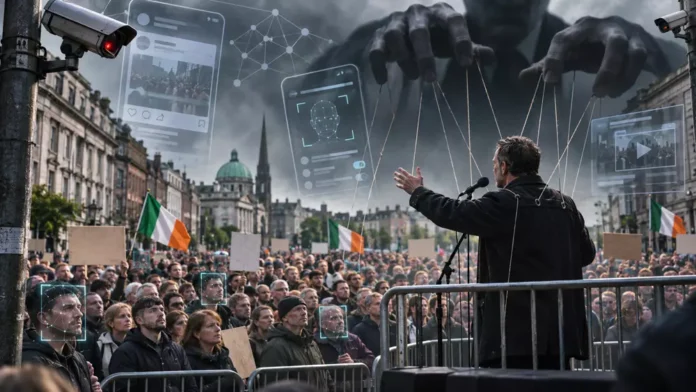
Before you follow the crowd, ask yourself who is leading it, who is watching it — and who might benefit from knowing you were there.
When people become frustrated with their government, taking to the streets is one of the most visible ways to express their dissatisfaction.
But how often do we question who organises these demonstrations?
Whether it is a peaceful march, a rally with patriotic speeches, a convoy of tractors or a road blockade, the same questions should apply.
Who is organising it? Who is financing it? Who decides what happens? And who benefits?
Most importantly, could there be another purpose behind a protest that ordinary participants know nothing about?
The Organisers Behind the Flags
Anyone can wave a national flag, deliver an emotional speech and claim to represent ordinary citizens.
But calling yourself a patriot does not automatically make you independent of the political establishment.
Before following any protest organiser, consider their background, political connections, sources of funding and previous activities.
Who pays for the advertising, transport, equipment and promotional campaigns?
Who selects the speakers?
Who decides which demands are presented to the government?
And what happens when participants disagree with the organisers?
There is nothing inherently suspicious about organising a demonstration. But neither should a crowd automatically trust someone simply because that person claims to be fighting for the people.
When Protests Become Carefully Managed Events
Many demonstrations follow a predictable pattern.
A date is announced. A route is selected. Speakers are chosen. Participants receive instructions about where to gather, where to march and when to leave.
They wave flags, chant slogans, listen to speeches and eventually return home.
The organisers celebrate the turnout and announce the next demonstration.
But what has actually changed?
A similar question applies to road blockades and vehicle convoys. Although they may cause greater disruption, they can still be directed by a small group deciding where participants go, how long they remain and when the action ends.
Planning is not necessarily manipulation. But organisation should serve the participants, not turn them into spectators following someone else’s instructions.
What If the Opposition Is Controlled?
One possibility worth examining is controlled opposition.
Could individuals presenting themselves as fierce opponents of the government actually have undisclosed relationships with political interests?
Could a movement be influenced to redirect public anger, discourage certain demands or repeatedly organise demonstrations that achieve little?
Such tactics would allow powerful interests to influence political opposition without openly suppressing it.
However, suspicion alone is not evidence. Demonstrating hidden political influence requires examining financial relationships, communications, appointments and actual decisions.
The question is not whether every organised protest is secretly controlled.
The question is whether ordinary people have enough information to recognise such influence if it exists.
What If the Protest Is Also a Data Collection Opportunity?
Here is another possibility that deserves serious consideration.
Facial recognition technology already exists. Cameras can record large crowds, while software can analyse images and, under certain conditions, compare faces with existing data.
So what happens when thousands of politically dissatisfied citizens gather in one location?
Their faces may be photographed, filmed, published online and associated with a particular political cause.
What becomes of those images?
Who stores them?
How long are they retained?
Could they eventually be combined with information from social media, public records or other sources?
And could information originally collected for one purpose later be used for another?
A particularly troubling hypothetical scenario would involve building profiles of people based on their participation in lawful political demonstrations.
Imagine citizens being quietly categorised according to their political opinions or their willingness to oppose government policies.
Could such information eventually influence how they are treated?
There is no established evidence that Irish fuel protests are being organised to create such lists. But the potential misuse of biometric technology is a legitimate civil-liberties concern.
In fact, Ireland has already legislated for certain retrospective biometric analysis capabilities, while European rules impose restrictions on the use of remote biometric identification.
These developments make independent oversight, clearly defined purposes and strict limits on data retention particularly important.
The public should not have to discover years later that footage gathered during a peaceful demonstration was used for purposes they never anticipated.
Personally, I recommend that protesters protect their privacy by wearing masks or other face coverings. A fully covered face can significantly hinder facial recognition technology. Exercising your right to protest should not mean giving up your right to privacy.
Social Media: From Censorship to Recommendations
Now consider another question.
In 2020, social media platforms were removing groups, restricting political content and shutting down accounts associated with certain movements.
Facebook, for example, openly announced a policy in October 2020 to remove groups and pages representing QAnon, even when those particular groups had not posted violent content.
During the COVID-19 period, platforms also introduced extensive restrictions and fact-checking measures affecting health-related content.
Yet today, social media users may encounter political groups, suggested communities, protest announcements and recommendations encouraging them to connect with others who share their dissatisfaction.
Why are certain political communities restricted at one moment, while other forms of political organising are actively recommended?
Platform policies change, and recommendations do not automatically establish a hidden political agenda.
But the contrast raises important questions about who decides which political movements gain visibility and which disappear.
Social media platforms are not neutral public squares. Their algorithms determine what users are shown, what they are encouraged to follow and which communities they are most likely to encounter.
An individual who joins a political group, reacts to protest material or regularly shares certain opinions may create an increasingly detailed digital record of their interests.
That information can be valuable for advertising, profiling and influencing what content reaches them.
So perhaps the question should not simply be why social media allows people to express political frustration.
It should also be what information is generated when they do.
Could Political Movements Become Psychological Operations?
The term PSYOP, short for psychological operation, describes the deliberate use of communication and other methods to influence the attitudes or behaviour of a target audience.
This concept raises questions about political mobilisation.
Could a movement encourage people to believe that major change is imminent while keeping them occupied with repeated demonstrations?
Could misleading promises create false expectations?
Could coordinated messaging redirect anger towards convenient targets?
And could provocateurs deliberately undermine a peaceful movement by encouraging actions that discredit its participants?
History provides examples of covert infiltration and disruption of political organisations, making scrutiny of such tactics reasonable.
But not every disappointing movement is a psychological operation, and not every disruptive participant is a planted provocateur.
Evidence matters.
The most useful approach is to examine how a movement operates, who influences its messages and whether its leadership is accountable to participants.
The Warning Signs People Should Question
Before joining an organised protest, ask yourself:
- Are the organisers open about their funding and political connections?
- Can ordinary participants influence decisions, or must they simply follow instructions?
- Are there clear objectives and measurable results?
- Do the organisers welcome criticism and independent investigation?
- Is personal information being collected, and who will have access to it?
- Are photographs, registration details or membership lists being retained without a clear explanation?
- Are social media groups encouraging people to reveal more personal information than necessary?
- Does the movement focus on achieving change, or primarily on promoting its leaders?
None of these questions requires abandoning the right to protest.
Quite the opposite.
They help citizens exercise that right without surrendering independent judgement.
Who Benefits When the People Follow?
An organised protest may genuinely represent public anger.
It may also provide publicity, influence, financial opportunities or political advantages to its organisers.
It can create pressure for change, but it can also collect valuable information about participants.
These possibilities are not mutually exclusive.
And they should not be ignored simply because the people leading the demonstration wear national colours and speak passionately about freedom.
The Irish people have every right to question their government.
They should be equally willing to question anyone claiming to lead the opposition.
The Final Question
If a government wanted to control public opposition, would it necessarily try to silence every protest?
Or would it be more effective to influence the people organising it?
And in an age of facial recognition, digital surveillance and social media profiling, there is another question worth asking:
What if the most valuable result of a protest was not what the crowd demanded — but what someone learned about the people who attended?
Before following the next self-proclaimed patriot, ask yourself:
Who is really behind the protest, who is watching, and who stands to benefit?