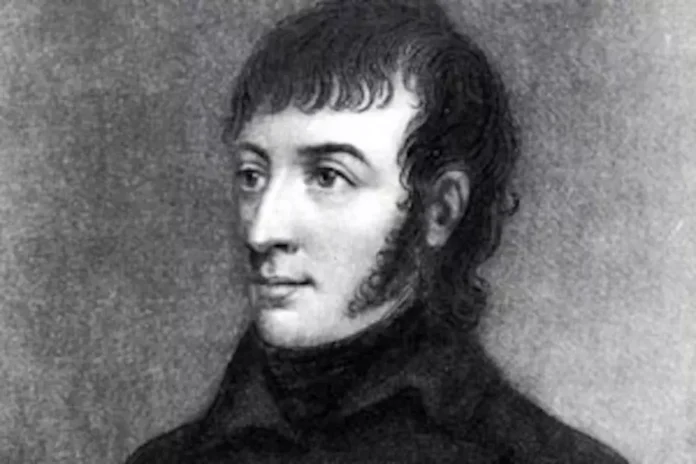
Born 21st November 1767
Executed 21st October 1803
He was one of the founding members of the United Irishmen
Born in Dromahane, County Cork on November 21st 1767, his father John was a junior officer in the British Army. Early in 1780s he was appointed at the Royal Hospital, Kilmainham, Dublin, and his family was assigned comfortable residential quarters at the hospital. Along with his brother Ambrose, Thomas joined the British army in 1783 and served in India.
His Studies
He returned to Ireland around 1786 on half pay and continued his studies in science, philosophy, and politics. He entered into the society of Whig liberalism, dominated by Henry Grattan; and in 1790 he met Theobald Wolfe Tone in the visitors’ gallery in the House of Commons, College Green, Dublin. They became very good friends.
In 1790 Russell resumed his military career as a junior officer in the 64th Regiment of Foot and was posted to Belfast. The French Revolution of 1789 had caused much excitement in the city.
The United Irishmen
He became acquainted with radical figures such as Henry Joy McCracken, Jamie Hope, Samuel Neilson and others who were to play a prominent role in the United Irish movement. Russell was founding member of the United Irishmen in 1791 and contributed to the society’s newspaper the Northern Star. In the summer of 1795, accompanied by Tone, Neilson, Simms and Henry Joy McCracken, he spent two days on Cave Hill overlooking Belfast. Those gathered pledged “never to desist in our efforts until we had subverted the authority of England over our country and asserted her independence”.
Russell then spent the next year crisscrossing Ulster promoting the United Irish cause, especially among, and between, the Presbyterians and Catholics. It was from the stories created at this time that the legend “The man from God-knows-where” was born. Throughout this period, he became known from Rathfriland to Rathlin Island. So effective was he that by July 1796 Lord Downshire, the governor of County Down, was informed that the “emissaries of the United Irishmen are astir in every quarter”. By 1792 he was the commander of the United Irishmen in County Down.
Arrest and Imprisonment
In 1796 he was arrested and imprisoned as a “state prisoner” in Dublin missing out in direct participation in the 1798 rising as a result. In March 1799 he and the other state prisoners were transferred to Fort George in Scotland, an extensive fortress some miles north of Inverness built in the wake of the failed Jacobite rebellion of 1745-46. After six years of imprisonment Russell, on his release, moved to Paris via Amsterdam. He was released on condition of exile to Hamburg in June 1802 following a brief cessation in Britain’s war with France.
Although unhappy with Bonaparte’s vision of the Revolution, he was keen to support Robert Emmet and his new United Irish project. Russell returned to his beloved County Down in May 1803 and tried, once again, to re-establish contact with former comrades, but support was in short supply.
Meeting with Robert Emmet
He soon made his way to Paris where he met Robert Emmet who was planning another insurrection pending the French renewal of the war against Britain. He agreed to return to Ireland in March 1803 to organise in Ulster in conjunction with the veteran of the Battle of Antrim Jamie Hope.
The plan however, was badly thought out and quickly collapsed forcing Russell to flee to Dublin before a shot was fired in anger. He managed to hide for a number of weeks but Dublin was a bad place to hide in the days following the failure of Emmett’s rebellion as the shocked authorities had launched a massive campaign of raids and arrests to finally eradicate the United Irishmen. He returned o Ulster in July and joined with Jamie Hope, to prepare for a Rebellion. However, support for a rebellion was not forthcoming and with the compromising of the plans for the rising in Dublin the project was doomed. A former ‘98 insurgent, informed Russell of the climate change in public opinion. He said nobody “but fools or madmen” would join him. Russell, having travelled to Antrim, eventually came to the conclusion that at that time, the cause was lost.
Downpatrick Gaol and Execution
Russell returned to Dublin and was promptly arrested and imprisoned in Kilmainham Jail. From there he was brought to Downpatrick to stand trial on a charge of high treason. In October, having been found guilty, Russell delivered an address, claiming he had “committed no moral evil”. He called himself “a soldier of the Lord Jesus Christ” and said he would “depart from this, for a better world”.
Russell was hanged and then beheaded on 21st October 1803 outside Downpatrick Jail. His last words were: “I forgive my persecutors; I die in peace with all mankind, and I hope for mercy through the merits of my Redeemer Jesus Christ.”
‘Into our townlan’, on a night of snow,
Rode a man from God-knows- where;’
These opening lines of the poem, ‘The man from God-knows-where’, were written about Thomas Russell, almost a century after Russell’s death, by Florence Mary Wilson. It is the eternal tribute to Thomas Russell the enigmatic general of the United Irish rebellion of 1803.
The Man from God Knows Where
Into our townlan’, on a night of snow,
Rode a man from God-knows-where;
None of us bade him stay or go,
Nor deemed him friend, nor damned him foe,
But we stabled his big roan mare:
For in our townlan’ we’re a decent folk,
And if he didn’t speak, why, none of us spoke,
And we sat till the fire burned low . . .
Two winters more, then the Trouble Year,
When the best that a man could feel
Was the pike that he kept in hidlin’s near,
Till the blood o’ hate an’ the blood o’ fear
Would be redder nor rust on the steel.
Us ones quet from mindin’ the farms,
Let them take what we gave wi’ the weight o’ our arms,
From Saintfield to Kilkeel . . .
By Downpatrick gaol I was bound to fare
On a day I’ll remember, feth;
For when I came to the prison square
The people were waitin’ in hundreds there,
An’ you wouldn’t hear stir nor breath!
For the sodgers were standing, grim an’ tall
Round a scaffold built there fornent the wall
An’ a man stepped out for death!
I was brave an’ near to the edge of the throng,
Yet I knowed the face again,
An’ I knowed the set, an’ I knowed the walk
An’ the sound of his strange up-country talk,
For he spoke out right an’ plain.
Then he bowed his head to the swinging rope,
Whiles I said “Please God” to his dying hope
And “Amen” to his dying prayer,
That the Wrong would cease and the Right prevail.
For the man that they hanged at Downpatrick Jail
Was the Man from God-knows-where!